
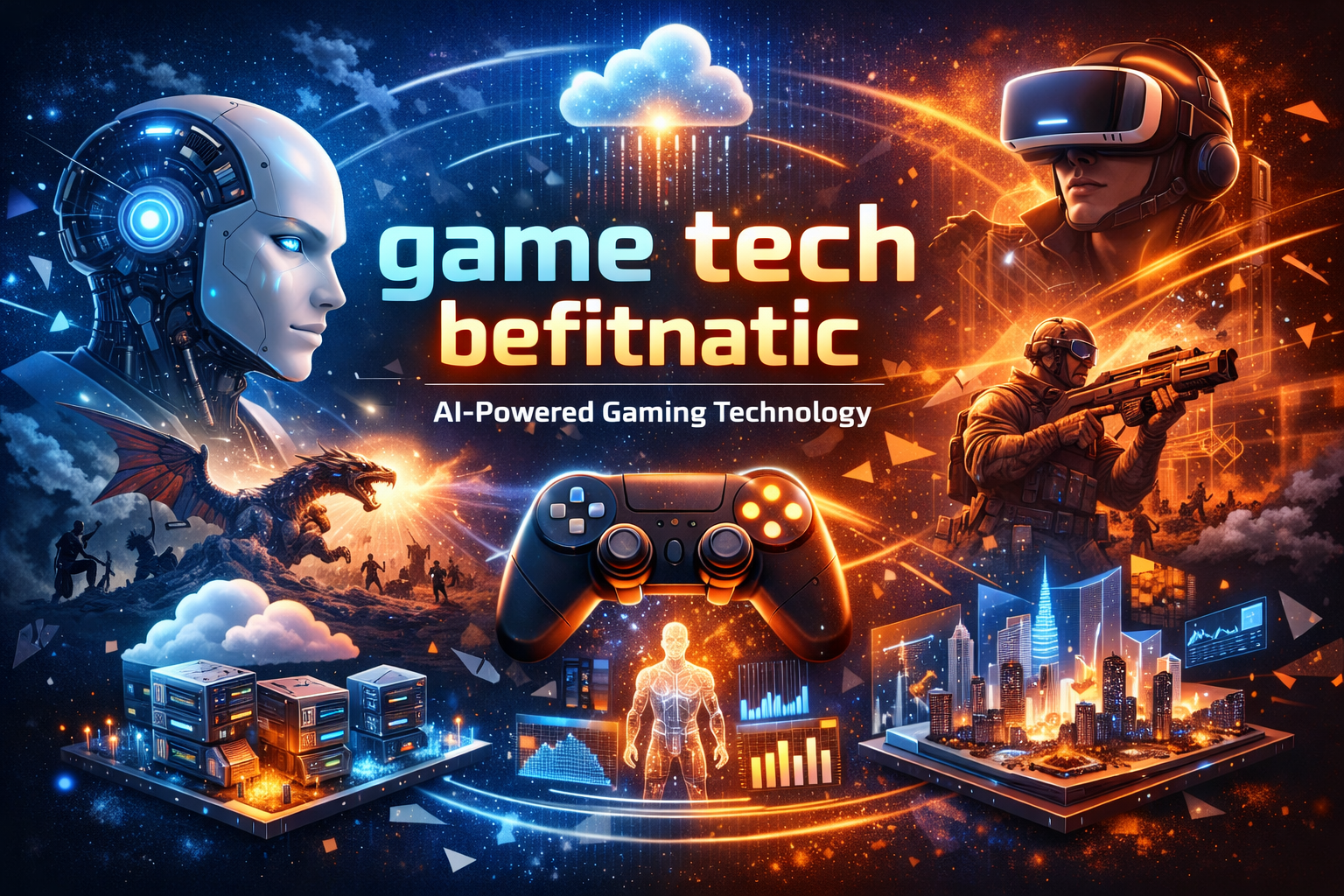
game tech befitnatic refers to a specialized category of gaming technology designed to enhance performance, scalability, and interactive user experiences. The term combines “game tech,” indicating gaming technology innovations, with “befitnatic,” highlighting advanced, adaptive, and modular technology systems in modern game development.
Core components
- Rendering engines – Handle real-time graphics, visual effects, and frame rendering.
- Physics engines – Simulate realistic in-game physics and interactions.
- AI & ML modules – Optimize gameplay, NPC behavior, and procedural content generation.
- Networking & cloud integration – Support multiplayer features, real-time synchronization, and cloud computing scalability.
- Toolkits & APIs – Facilitate integration with platforms, middleware, and developer workflows.
How it differs from traditional gaming technology
- Modular and adaptive architecture vs monolithic traditional engines.
- Strong focus on AI/ML optimization for performance and user engagement.
- Cloud-ready infrastructure allowing scalable multiplayer and streaming experiences.
- Designed for rapid iteration and cross-platform deployment.
Summary
game tech befitnatic is a modern gaming technology category that combines real-time rendering, AI-driven optimization, physics simulation, and cloud integration to provide scalable, high-performance, and interactive gaming experiences.
For updates on the latest features, see our latest game updates befitnatic guide.
Key Takeaways
- Advanced category of gaming technology
- Integrates AI, cloud, and physics engines
- Modular, scalable, and performance-focused
- Distinct from traditional monolithic game engines
Pros / Cons
Pros:
- Enhanced performance and engagement
- Scalability across platforms
- AI-driven adaptability
Cons:
- Higher complexity in development
- Requires robust hardware and infrastructure
How game tech befitnatic Works — Architecture & Key Technologies
game tech befitnatic operates on a modular and layered architecture, designed to provide flexibility, scalability, and high performance in modern gaming environments. At the core, the system is structured into multiple layers: the engine layer handles rendering, physics, and AI computations; the middleware layer connects third-party tools, APIs, and plugins; the networking layer supports multiplayer functionality and cloud interactions; and the user interface layer manages in-game HUDs, menus, and interactive feedback systems.
Real-time processing and rendering are central to game tech befitnatic. The graphics pipeline ensures smooth frame-by-frame rendering of 2D and 3D assets, optimized for high FPS and low latency. Advanced shader programming, lighting effects, and texture management enhance visual realism. Simultaneously, the physics engine simulates realistic motion, collisions, and environmental interactions, creating dynamic and responsive game worlds. These physics calculations are tightly integrated with AI modules to ensure natural behavior in objects, characters, and the environment.
AI and machine learning play a pivotal role in game tech befitnatic. These technologies are used for procedural content generation, including levels, maps, and scenarios, ensuring that games remain fresh and unpredictable. NPC behavior is dynamically adjusted using predictive models, while adaptive difficulty systems maintain player engagement. Additionally, AI-driven analytics monitor player behavior and performance, providing insights that can improve retention and gameplay experience.
Networking and cloud integration further distinguish game tech befitnatic from traditional game technologies. The architecture supports real-time multiplayer gameplay, matchmaking, and global player synchronization. Cloud-hosted services provide scalable storage, computing power, and streaming capabilities, which reduce latency and allow seamless access to games from multiple regions. This combination of cloud integration and modular architecture ensures both performance and accessibility.
Key Points:
- Modular architecture ensures flexibility and scalability.
- Graphics and physics engines enable high-quality visuals and realistic interactions.
- AI/ML modules optimize gameplay, procedural content, and predictive analytics.
- Cloud integration supports multiplayer and global accessibility.
Summary
game tech befitnatic uses a modular, layered architecture that integrates graphics, physics, AI, and cloud networking to deliver scalable, high-performance, and interactive gaming experiences.
Key Takeaways
- Layered architecture for performance and flexibility
- Real-time rendering and physics simulation
- AI-enhanced content and adaptive gameplay
- Cloud-enabled multiplayer and streaming
Key Benefits of game tech befitnatic
game tech befitnatic offers a range of benefits that make it a valuable technology category in modern gaming. Its design focuses on enhancing performance, scalability, and user engagement while reducing development limitations commonly found in traditional game engines.
One of the primary advantages is performance improvement. By integrating real-time rendering engines, physics simulations, and AI-driven optimizations, game tech befitnatic ensures smoother gameplay, higher frame rates, and low latency, even in graphically intensive environments. This results in a more immersive and responsive gaming experience.
Another key benefit is enhanced user engagement. The technology leverages AI and machine learning to create adaptive gameplay, procedural content, and intelligent NPC behavior. Players experience dynamic and evolving game worlds that respond to their actions, which increases retention and satisfaction.
Scalability and flexibility are also central to game tech befitnatic. Its modular architecture allows developers to integrate new tools, plugins, or updates without overhauling the entire system. Cloud integration ensures that multiplayer sessions, streaming, and content delivery remain seamless across platforms and regions.
Finally, cost efficiency is achieved through optimized resource management. Cloud hosting reduces infrastructure costs, AI-driven automation accelerates content creation, and modular frameworks minimize development time. Organizations can deploy complex games faster while maintaining high-quality performance.
Summary
game tech befitnatic improves gaming performance, engagement, and scalability while reducing costs, making it a modern solution for developers and studios seeking advanced, interactive gaming experiences.
Security and platform reliability are critical, as highlighted in the TataSec secure portal resources.
Key Takeaways
- High-performance gameplay with low latency
- Adaptive, AI-driven engagement for players
- Scalable and modular for cross-platform use
- Optimized for cost efficiency and faster development
Pros / Cons
Pros:
- Enhanced performance and realism
- Improved player retention and engagement
- Flexible, modular architecture
- Cloud-enabled scalability
Cons:
- Higher learning curve for development teams
- Initial setup can be resource-intensive
Common Challenges & Limitations
While game tech befitnatic provides advanced capabilities, it comes with certain challenges that developers and organizations need to consider. Understanding these limitations helps in planning projects effectively and avoiding unexpected issues.
One major challenge is hardware constraints. High-performance rendering, real-time physics, and AI computations require powerful GPUs, CPUs, and sufficient memory. Developers targeting lower-end devices or cross-platform deployment may need to optimize features to maintain smooth performance.
Another limitation is development complexity. The modular architecture and integration of multiple components—graphics engines, AI modules, networking, and cloud services—demand specialized skills. Teams must coordinate across multiple technical domains, which can extend development timelines and increase costs.
Compatibility issues also arise, especially when integrating game tech befitnatic with existing systems, third-party tools, or legacy platforms. Ensuring smooth operation across different hardware configurations, operating systems, and cloud environments requires extensive testing and optimization.
Additionally, maintenance and updates can be resource-intensive. Continuous improvements in AI, cloud infrastructure, and rendering technologies necessitate regular updates to keep games optimized, secure, and competitive.
Summary
game tech befitnatic is highly advanced but presents challenges such as hardware requirements, development complexity, compatibility concerns, and ongoing maintenance needs. Proper planning and technical expertise are essential to maximize its potential.
Key Takeaways
- Requires high-performance hardware
- Complex, multi-domain development process
- Compatibility testing is critical for cross-platform deployment
- Continuous updates needed for optimal performance
Pros / Cons
Pros:
- Cutting-edge technology with advanced capabilities
- Supports scalable, AI-enhanced gaming
Cons:
- High development complexity
- Requires robust hardware
- Ongoing maintenance can be resource-intensive
game tech befitnatic Use Cases Across Industries
game tech befitnatic has versatile applications across multiple industries, extending beyond traditional gaming. Its combination of real-time rendering, AI-driven interactivity, and cloud scalability makes it valuable for entertainment, professional training, and educational environments.
In entertainment and gaming studios, game tech befitnatic is used to create immersive game worlds, realistic graphics, and adaptive gameplay. Studios leverage its AI modules for procedural content generation and dynamic NPC behavior, enhancing player engagement and retention. Cloud integration also allows large-scale multiplayer games to operate seamlessly worldwide.
In the esports ecosystem, the technology supports real-time performance tracking, analytics, and dynamic match simulations. High-performance rendering ensures smooth gameplay for professional competitions, while AI analytics provide insights into player performance and strategies.
For simulation training, industries like aviation, military, and healthcare utilize game tech befitnatic to create realistic training scenarios. Its physics engines and immersive graphics allow trainees to practice in safe, controlled virtual environments that replicate real-world conditions.
In interactive education, the technology enables gamified learning experiences. Students engage with dynamic simulations, interactive problem-solving, and virtual experiments, improving comprehension and retention. AI-driven adaptation ensures that content aligns with each learner’s pace and skill level.
Summary
game tech befitnatic powers a wide range of applications—from immersive gaming and esports to professional simulation training and interactive education—by combining AI, real-time graphics, and scalable cloud infrastructure.
Key Takeaways
- Entertainment & gaming studios: dynamic, engaging gameplay
- Esports: real-time analytics and smooth performance
- Simulation training: realistic virtual environments
- Interactive education: gamified, adaptive learning experiences
Pros / Cons
Pros:
- Diverse applications across industries
- Enhances engagement and learning outcomes
- Supports large-scale, cloud-enabled experiences
Cons:
- Requires specialized development expertise
- May demand significant computational resources
game tech befitnatic vs Related Game Technologies
game tech befitnatic distinguishes itself from other gaming technologies through its modular design, AI integration, and cloud-ready architecture. Understanding these differences helps developers and organizations choose the right technology for their projects.
game tech befitnatic vs Traditional Game Engines
Traditional game engines often rely on monolithic architectures and require extensive manual optimization. In contrast, game tech befitnatic offers:
- Modular components for easier updates and expansion
- AI/ML-driven procedural content generation
- Enhanced real-time performance with optimized rendering and physics
game tech befitnatic vs Cloud Gaming Technology
While cloud gaming primarily focuses on delivering games via streaming, game tech befitnatic is a full-stack technology category. Key advantages include:
- Local and cloud-based hybrid processing for optimal performance
- Integrated AI for dynamic gameplay
- Scalable multiplayer and interactive features
game tech befitnatic vs AI-Enhanced Graphics
AI-enhanced graphics often focus solely on visual improvements. game tech befitnatic incorporates AI for:
- Gameplay optimization
- Procedural content generation
- NPC behavior modeling
- Predictive analytics for user engagement
Summary
game tech befitnatic combines AI, cloud scalability, and modular design, making it more versatile than traditional engines, cloud-only solutions, or graphics-focused AI technologies.
Key Takeaways
- Modular, AI-driven, and cloud-ready architecture
- Optimized for performance, scalability, and engagement
- Integrates multiple technologies beyond visuals
Pros / Cons
Pros:
- Versatile and comprehensive technology solution
- Enhanced user engagement and adaptability
- Scalable across platforms and industries
Cons:
- Requires multi-domain expertise to implement
- Higher initial development complexity
How to Implement game tech befitnatic — Step-by-Step
Implementing game tech befitnatic requires a structured approach that ensures performance, scalability, and seamless integration. Following best practices helps developers reduce complexity and achieve optimal results.
Step 1: Technology Selection
Begin by identifying the required components for your project: rendering engines, physics engines, AI/ML frameworks, and cloud services. Consider compatibility with existing tools, project scope, and target platforms. Selecting modular and scalable solutions is key for future-proofing your development.
Step 2: Development Workflow
Establish a development pipeline that integrates all layers of game tech befitnatic: core engine, middleware, networking, and user interface. Implement version control, continuous integration, and testing to maintain code quality. Agile methodologies help manage iterative development and updates efficiently.
Step 3: Testing & Optimization
Rigorous testing ensures smooth performance and user experience. Focus on:
- Frame rate consistency and low latency
- Physics and collision accuracy
- AI behavior and procedural content functionality
- Network performance for multiplayer or cloud features
Step 4: Deployment Strategies
Deploy the game using scalable cloud infrastructure to handle global access and multiplayer sessions. Optimize for cross-platform compatibility and prepare update pipelines for ongoing maintenance. Use analytics and performance monitoring to continuously improve the user experience.
Summary
Implementing game tech befitnatic involves selecting compatible technologies, establishing a robust development workflow, performing thorough testing, and deploying using scalable cloud infrastructure.
Developers can refer to the PBLinuxGaming setup guide for configuring emulator tools and related tech workflows.
Key Takeaways
- Choose modular, scalable technologies
- Integrate all layers in a structured development workflow
- Test performance, AI, and network functionality
- Deploy using cloud infrastructure with monitoring for continuous improvement
Pros / Cons
Pros:
- Structured approach reduces errors and development time
- Ensures performance and scalability
- Supports iterative improvements
Cons:
- Requires expertise across multiple domains
- Initial setup and testing can be resource-intensive
Future Trends in game tech befitnatic
The future of game tech befitnatic is shaped by advances in AI, immersive technologies, and predictive analytics. These trends are set to transform the gaming landscape and expand applications across industries.
AI and Procedural Generation
AI will continue to drive procedural content creation, enabling dynamically generated levels, adaptive storylines, and realistic NPC behavior. This reduces development time while offering personalized player experiences.
Immersive Technology Integration (AR/VR)
Augmented Reality (AR) and Virtual Reality (VR) are increasingly integrated with game tech befitnatic, providing fully immersive environments. These technologies enhance player engagement, offering interactive and realistic experiences in both gaming and simulation training.
Predictive Analytics
Using AI-driven analytics, developers can predict player behavior, optimize in-game events, and enhance retention. Predictive insights allow real-time adjustments to gameplay, ensuring higher engagement and satisfaction.
Cloud-Native and Cross-Platform Expansion
Future trends emphasize cloud-native architectures and cross-platform capabilities. Games built on game tech befitnatic will seamlessly support multiple devices, reduce latency through edge computing, and leverage scalable cloud infrastructures for global multiplayer experiences.
Summary
Future developments in game tech befitnatic will focus on AI-driven procedural generation, immersive AR/VR integration, predictive analytics, and cloud-native architectures, making gaming more dynamic, interactive, and globally accessible.
Key Takeaways
- AI enhances procedural content and NPC behavior
- AR/VR integration offers immersive experiences
- Predictive analytics improves player engagement
- Cloud-native solutions ensure scalability and cross-platform access
Pros / Cons
Pros:
- Dynamic, personalized gameplay experiences
- Immersive and interactive technologies
- Scalable and globally accessible infrastructure
Cons:
- Requires investment in emerging tech
- Complex integration with existing systems
Conclusion
game tech befitnatic represents a transformative category in modern gaming technology, combining real-time rendering, AI-driven optimization, physics simulations, and cloud scalability. It enhances performance, engagement, and adaptability across a variety of applications, from entertainment and esports to simulation training and interactive education. While implementation requires technical expertise and robust infrastructure, the modular architecture, AI integration, and cloud-native design ensure scalable, high-quality, and immersive experiences. As AI, AR/VR, and predictive analytics continue to evolve, game tech befitnatic is poised to shape the future of interactive and adaptive gaming.
As technology continues to evolve, integrating game tech befitnatic with emerging tools and standards (see Gaming Technology Overview – Wikipedia) can further enhance gameplay, training simulations, and interactive educational platforms
FAQs
Q1: What is game tech befitnatic?
game tech befitnatic is a category of gaming technology that integrates real-time rendering, AI-driven optimization, physics simulation, and cloud scalability to deliver high-performance, interactive, and adaptive gaming experiences.
Q2: How does game tech befitnatic improve performance?
It enhances performance through optimized graphics pipelines, physics engines, and AI modules that reduce latency, increase frame rates, and provide smooth, responsive gameplay across devices.
Q3: Is game tech befitnatic the same as a game engine?
No. While it includes engine-like components, game tech befitnatic is broader, incorporating AI, cloud infrastructure, modular architecture, and advanced analytics beyond traditional engines.
Q4: What industries use game tech befitnatic?
It is used in gaming studios, esports, simulation training (aviation, military, healthcare), and interactive education, enabling immersive experiences and adaptive content delivery.
Q5: How to implement game tech befitnatic?
Implementation involves selecting compatible technologies, building a structured development workflow, performing rigorous testing of graphics, physics, and AI modules, and deploying via scalable cloud infrastructure.
Q6: What are the main benefits of game tech befitnatic?
Key benefits include high-performance gameplay, enhanced user engagement, scalability, AI-driven content generation, and cost-efficient development and deployment.
Q7: What challenges should developers expect?
Challenges include high hardware requirements, complex development processes, compatibility issues, and ongoing maintenance needs for AI, cloud, and rendering systems.
References
- Industry benchmarks and technical standards on game engines and AI integration. (According to leading gaming technology research platforms)
- Real-time rendering and physics engine documentation. (Based on graphics APIs like DirectX and Vulkan)
- AI and procedural content generation studies in gaming. (Documented by research in AI-driven game development)
- Cloud-based gaming and networking integration reports. (Observed in global cloud gaming platforms)
- Case studies of simulation training and interactive education using advanced gaming technologies. (Documented by professional training and edtech providers)
- Esports performance analytics and AI applications. (Based on industry reports and analytics platforms)
- AR/VR integration in gaming and training environments. (Documented by immersive technology research labs)