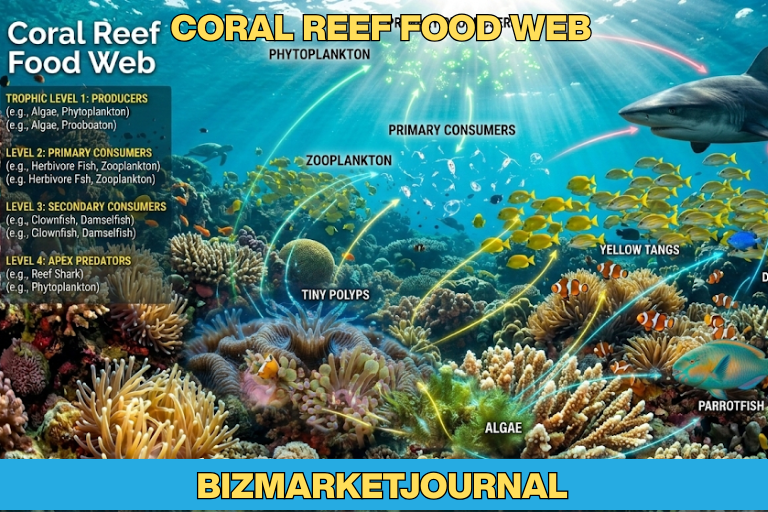
The coral reef food web in Monroe County begins with microscopic and benthic primary producers that convert solar energy into biological biomass. These organisms form the energetic base of the coral reef food chain and determine the carrying capacity of higher trophic levels within the Florida Keys reef ecosystem.
Zooxanthellae – The Symbiotic Energy Engine
Zooxanthellae are photosynthetic dinoflagellates living within coral tissues. Through photosynthesis, they convert sunlight into carbohydrates, supplying up to 90% of the metabolic energy required by reef-building corals.
In the Monroe County reef system, this symbiosis powers calcification, reef accretion, and habitat formation. However, thermal stress events documented by NOAA in recent years have disrupted this relationship, triggering coral bleaching and weakening the coral reef food web at its foundation.
Ecological Mechanism:
- Sunlight → Photosynthesis by zooxanthellae
- Glucose transfer → Coral host metabolism
- Enhanced calcification → Reef structural complexity
Seagrasses & Macroalgae as Base Biomass
Seagrass meadows and macroalgae contribute substantial primary production within the coral reef food web of the Florida Keys. Seagrasses stabilize sediments, sequester carbon, and provide nursery habitat for juvenile fish species.
Macroalgae, while natural components of the coral reef food chain, can dominate reef surfaces when herbivory declines. In Monroe County, balanced grazing pressure from parrotfish and urchins prevents algal overgrowth, maintaining trophic equilibrium.
Functional Roles:
- Carbon fixation
- Nutrient cycling
- Juvenile habitat provisioning
- Detrital input into reef sediment systems
Keystone Coral Species as Structural Habitat
Although corals are animals, reef-building species function as ecosystem engineers within the coral reef food web.
Key Monroe County reef builders include:
- Great Star Coral
- Elkhorn Coral
These species create three-dimensional reef architecture that increases niche availability, predator refuge, and biodiversity density. Structural complexity directly influences trophic diversity in the coral reef food chain, supporting fish biomass and predator abundance.
Summary
The coral reef food web of Monroe County is powered by photosynthetic symbionts, seagrasses, and algae. Without these primary producers, energy transfer to herbivores, carnivores, and apex predators collapses. Thermal stress in 2026 continues to challenge this foundational trophic level.
Key Takeaways
- Zooxanthellae drive reef productivity via symbiotic photosynthesis.
- Seagrass meadows enhance carbon storage and juvenile fish survival.
- Macroalgae are essential but require herbivore regulation.
- Structural corals amplify biodiversity by increasing habitat complexity.
- Disruption at the primary producer level destabilizes the entire coral reef food web.
Pros vs. Cons (Ecological Stability Perspective)
Pros
- High solar energy conversion efficiency
- Strong habitat engineering capacity
- Supports dense trophic networks
Cons
- Sensitive to temperature anomalies
- Vulnerable to acidification impacts on calcification
- Dependent on stable herbivore populations
Common Misconception
“Corals are rocks or plants.”
Corals are marine invertebrate animals. Their productivity in the coral reef food comes from symbiosis with photosynthetic zooxanthellae—not from being plants themselves.

The Coral Reef Food Chain: From Polyps to Predators
The coral reef food in Monroe County functions as an interconnected trophic network where energy flows from microscopic primary producers to apex predators. While the coral reef food chain describes a linear pathway of energy transfer, the food web reflects the complex, overlapping feeding relationships that define the Florida Keys reef ecosystem.
Within the boundaries of the Florida Keys National Marine Sanctuary, this trophic structure determines reef resilience, fish biomass distribution, and predator density.
What Is a Coral Reef Food Chain?
A coral reef food chain is the linear progression of energy transfer beginning with primary producers such as zooxanthellae and algae, moving to herbivores, then carnivorous fish, and ultimately reaching apex predators. In reality, these chains interconnect to form a coral reef food web, where species occupy multiple trophic interactions simultaneously.
Definition:
A trophic cascade on a coral reef occurs when changes in predator populations alter herbivore density, which in turn affects algal growth and coral health. These cascading effects restructure the coral reef food web and influence overall ecosystem stability.
Primary Consumers (Herbivores & Grazers)
Primary consumers form the second trophic level in the coral reef food chain. In Monroe County reefs, herbivorous fish and invertebrates regulate algal biomass, preventing competitive exclusion of corals.
Key herbivores include:
- Parrotfish
- Surgeonfish
- Sea urchins
Their grazing activity:
- Reduces macroalgal overgrowth
- Enhances coral larval settlement
- Maintains light penetration for photosynthesis
When herbivore biomass declines, algal dominance increases, weakening the coral reef food at multiple trophic levels.
Secondary Consumers (Carnivorous Reef Fish)
Secondary consumers prey on herbivores and smaller reef organisms, transferring energy upward within the coral reef food web.
Representative species in Monroe County include:
- Yellowtail snapper
- Black grouper
- Goliath Grouper
These predators regulate mid-level fish populations and help prevent trophic imbalance. The recovery of large-bodied groupers in protected areas of the Florida Keys has strengthened trophic linkages in recent years.
Apex Predators of the Florida Keys
At the top of the coral reef food web are apex predators that exert strong top-down control.
Key apex species include:
- Caribbean reef sharks
- Great barracuda
Apex predators:
- Regulate mesopredator populations
- Prevent overconsumption of herbivores
- Stabilize trophic cascades
Protected “No-Take” zones within the sanctuary demonstrate higher predator biomass compared to fished reefs, reinforcing the structural integrity of the coral reef food chain in Monroe County.
Trophic Levels of the Florida Keys
| Trophic Level | Key Species | Primary Diet | Ecological Role |
|---|---|---|---|
| Primary Producers | Zooxanthellae, Seagrass, Algae | Sunlight, CO₂ | Energy generation |
| Primary Consumers | Parrotfish, Sea Urchins | Algae | Algal control |
| Secondary Consumers | Snappers, Groupers | Herbivorous fish/invertebrates | Population regulation |
| Apex Predators | Reef Sharks, Barracuda | Carnivorous fish | Trophic stabilization |
| Detritivores | Worms, Crustaceans | Organic detritus | Nutrient recycling |
Summary
The coral reef food web in the Florida Keys transfers energy upward with roughly 10% efficiency between trophic levels. This limited energy retention makes apex predators dependent on a highly productive base. Disruptions at lower levels cascade upward, restructuring the coral reef food chain.
Key Takeaways
- The coral reef food chain is linear; the coral reef food web is interconnected.
- Herbivores are essential for coral dominance over algae.
- Secondary consumers regulate mid-level populations.
- Apex predators prevent destabilizing trophic cascades.
- Protected marine zones strengthen predator-driven stability.
Pros vs. Cons (Predator Regulation Model)
Pros
- Strong top-down ecological control
- Balanced algal growth
- Enhanced biodiversity
Cons
- Vulnerable to overfishing
- Slow predator recovery rates
- Energy inefficiency between trophic levels

Keystone Species: Why Parrotfish and Diadema Matter
Within the coral reef food web of Monroe County, certain organisms exert an ecological influence disproportionate to their biomass. These keystone species regulate algal growth, facilitate coral recruitment, and stabilize trophic pathways across the broader coral reef food chain of the Florida Keys.
In 2026, herbivore restoration and invertebrate recovery are central to reef resilience strategies inside the Florida Keys National Marine Sanctuary.
Parrotfish and Reef Resilience
Parrotfish are primary consumers that directly shape the coral reef food web through continuous grazing. Their scraping and excavating feeding modes remove turf algae and macroalgae from reef substrates.
Ecological functions include:
- Suppression of algal overgrowth
- Increased coral larval settlement success
- Bioerosion contributing to carbonate sand production
- Maintenance of benthic space for coral recruitment
In Monroe County reefs, parrotfish biomass correlates strongly with coral cover stability. Where herbivore density remains high, algal dominance is reduced, preventing trophic imbalance within the coral reef food chain.
A decline in parrotfish leads to measurable shifts in benthic composition, reinforcing their keystone role in maintaining trophic equilibrium.
The Return of Diadema Sea Urchins
Long-spined sea urchins (genus Diadema) were historically dominant grazers in the Florida Keys before a region-wide die-off in the 1980s. Their collapse triggered a documented trophic cascade, resulting in macroalgal expansion and coral decline.
Recent restoration and hatchery-based reintroduction efforts in Monroe County have increased localized Diadema densities.
Ecological contributions:
- Intensive grazing on turf algae
- Rapid response to algal blooms
- Complementary herbivory alongside parrotfish
The re-establishment of Diadema populations strengthens the lower trophic stability of the coral reef food web, particularly in areas where fish herbivory alone is insufficient.
Caribbean Spiny Lobster in the Mid-Trophic Role
Caribbean Spiny Lobster occupies a mid-trophic position within the coral reef food chain. It preys on mollusks, small crustaceans, and benthic invertebrates, linking lower trophic levels to larger predators.
Ecological and economic significance in Monroe County:
- Regulates benthic invertebrate populations
- Serves as prey for large fish and sharks
- Supports a major regional fishery
Balanced lobster populations contribute to trophic complexity and nutrient cycling within the coral reef food web. Overharvesting, however, can disrupt benthic community structure.
Predator–Prey Matrix (Monroe County Model)
| Predator | Primary Prey | Ecological Effect |
|---|---|---|
| Parrotfish | Turf algae, macroalgae | Prevents algal dominance |
| Diadema urchins | Turf algae | Enhances coral recruitment |
| Caribbean Spiny Lobster | Mollusks, small crustaceans | Regulates benthic invertebrates |
| Goliath Grouper | Crustaceans, fish | Controls mid-level consumers |
| Reef Sharks | Large reef fish | Stabilizes upper trophic structure |
Summary
The coral reef food web of Monroe County depends heavily on herbivorous grazers and mid-level regulators. Parrotfish and Diadema prevent macroalgal takeover, while Caribbean spiny lobsters maintain benthic balance. Their combined influence reinforces trophic stability across the coral reef food chain.
Key Takeaways
- Keystone species exert ecosystem-wide influence beyond their abundance.
- Herbivore recovery directly improves coral settlement rates.
- Diadema reintroduction mitigates algal dominance.
- Caribbean spiny lobsters link benthic prey to higher predators.
- Functional redundancy among grazers increases reef resilience.
Pros vs. Cons (Herbivore-Driven Stability)
Pros
- Strengthened algal control
- Improved coral recruitment
- Enhanced trophic redundancy
Cons
- Susceptible to disease outbreaks
- Dependent on fishing regulations
- Sensitive to habitat degradation
Common Misconception
“Only large predators shape the coral reef food web.”
In reality, herbivores such as parrotfish and Diadema exert equally critical control. Without their grazing pressure, the coral reef food chain shifts toward algal dominance, destabilizing the entire trophic network.

Threats to the Trophic Balance in 2026
The coral reef food web in Monroe County faces accelerating stressors in 2026. Thermal anomalies, acidification, overfishing, and habitat fragmentation are restructuring trophic relationships within the coral reef food chain of the Florida Keys. Even within the Florida Keys National Marine Sanctuary, resilience depends on adaptive management and restoration scaling.
Marine Heatwaves and Coral Bleaching
Elevated sea surface temperatures remain the most immediate threat to the coral reef food web. When temperature thresholds are exceeded, corals expel symbiotic algae, reducing primary productivity at the base of the coral reef food chain.
According to monitoring frameworks from NOAA:
- Prolonged heat stress reduces calcification rates
- Bleaching lowers coral survival probability
- Structural complexity declines with coral mortality
Because reef-building corals generate habitat for multiple trophic levels, bleaching events weaken predator-prey networks across the entire coral reef food web.
Ocean Acidification and Calcification Loss
Increased atmospheric CO₂ lowers ocean pH, impairing carbonate ion availability required for coral skeleton formation.
Impacts on the coral reef food chain include:
- Slower reef accretion
- Reduced structural habitat
- Increased erosion vulnerability
Lower calcification compromises three-dimensional reef architecture, decreasing niche diversity and fish biomass within the coral reef food web of Monroe County.
Overfishing and Predator Removal
Fishing pressure alters trophic distribution by removing key species from the coral reef food chain.
Consequences include:
- Decline in apex predator biomass
- Mesopredator release
- Herbivore overconsumption or depletion
In systems where predator density is reduced, trophic cascades can destabilize the coral reef food web, leading to shifts in benthic composition and reduced biodiversity.
Protected No-Take Zones and Predator Recovery
Spatial management tools, including no-take reserves within the sanctuary and at John Pennekamp Coral Reef State Park, demonstrate measurable increases in predator biomass relative to adjacent fished reefs.
Observed ecological effects:
- Higher shark and large grouper density
- Stabilized mesopredator populations
- Improved herbivore balance
- Enhanced coral recruitment rates
In 2026, protected zones serve as trophic refugia that reinforce the structural integrity of the coral reef food web.
Energy Transfer Efficiency in Reef Systems
| Trophic Level | Approximate Energy Retention | Biomass Implication |
|---|---|---|
| Primary Producers | 100% (base input) | High productivity foundation |
| Primary Consumers | ~10% | Limited herbivore biomass |
| Secondary Consumers | ~1% | Reduced carnivore density |
| Apex Predators | <0.1% | Naturally low population density |
Low energy transfer efficiency highlights why disruptions at lower trophic levels cascade upward through the coral reef food.
Summary
The coral reef food web in Monroe County is under sustained environmental stress. Marine heatwaves weaken primary production, acidification reduces reef structure, and fishing pressure alters trophic balance. However, protected zones and restoration programs are strengthening localized resilience within the coral reef food chain.
Key Takeaways
- Thermal stress is the dominant destabilizing factor in 2026.
- Acidification reduces structural habitat complexity.
- Predator removal reshapes trophic cascades.
- No-take zones increase apex predator biomass.
- Resilience depends on protecting lower trophic productivity.
Pros vs. Cons (Current Ecological State)
Pros
- Expanding protected marine areas
- Improved predator recovery inside reserves
- Active coral outplanting initiatives
Cons
- Intensifying marine heatwaves
- Ongoing acidification trends
- External stressors beyond local management control

Conclusion
The coral reef food web in Monroe County represents one of the most structurally complex and scientifically studied marine trophic systems in the continental United States. From zooxanthellae-driven primary production to apex predator regulation, the coral reef food chain of the Florida Keys operates as a tightly interconnected energy network.
In 2026, resilience depends on three pillars: maintaining herbivore biomass, protecting apex predators within the Florida Keys National Marine Sanctuary, and scaling coral restoration initiatives. Disruptions at any trophic level cascade throughout the coral reef food web, underscoring the need for ecosystem-based management and climate-adaptive conservation policy.
For a contrasting cold-climate ecosystem model, explore our Best Tundra Food Web – North Slope Food Chain & Iñupiat Guide 2026 to compare Arctic trophic structures with Florida’s coral reef food web.
Frequently Asked Questions
1. What is the coral reef food web in the Florida Keys?
The coral reef food web in the Florida Keys is a multi-layered trophic network where energy flows from photosynthetic organisms such as zooxanthellae and seagrasses to herbivores, carnivorous reef fish, and apex predators. It reflects interconnected feeding relationships rather than a simple linear coral reef food chain.
2. How is a coral reef food chain different from a food web?
A coral reef food chain shows a single, linear pathway of energy transfer. In contrast, a coral reef food web illustrates multiple overlapping feeding interactions among species across trophic levels, providing a more accurate representation of ecological dynamics in Monroe County reefs.
3. Why are parrotfish important in the coral reef food web?
Parrotfish are primary consumers that control algal growth. By grazing macroalgae, they prevent algal dominance, promote coral settlement, and stabilize the lower trophic levels of the coral reef food chain. Their role directly supports reef resilience in the Florida Keys.
4. What is a trophic cascade on a coral reef?
A trophic cascade occurs when changes in predator populations alter herbivore density, which then affects algal growth and coral survival. In the coral reef food web, such cascades can shift reefs from coral-dominated to algae-dominated states if trophic balance is disrupted.
5. How do marine heatwaves affect the coral reef food web in 2026?
Marine heatwaves cause coral bleaching by disrupting the symbiosis between corals and zooxanthellae. This reduces primary productivity at the base of the coral reef food chain, weakening energy transfer to herbivores and predators throughout the ecosystem.
6. Do protected areas improve the coral reef food chain?
Yes. No-take zones within the Florida Keys increase predator biomass and restore trophic balance. Higher apex predator density reduces mesopredator imbalances and strengthens overall coral reef food web stability.
7. What role does NOAA play in monitoring Monroe County reefs?
NOAA conducts coral bleaching surveillance, temperature monitoring, and reef health assessments. Its data informs management strategies designed to protect the coral reef food web of the Florida Keys.
References
- NOAA – Coral Reef Watch & Florida Keys monitoring programs
- Florida Keys National Marine Sanctuary – Ecosystem condition reports and management plans
- Florida Fish and Wildlife Conservation Commission – Fisheries and herbivore protection policies
- Coral Restoration Foundation – Coral outplanting and reef restoration initiatives
- University of Miami Rosenstiel School of Marine, Atmospheric, and Earth Science – Peer-reviewed reef ecology research
- U.S. Environmental Protection Agency – Ocean acidification assessments