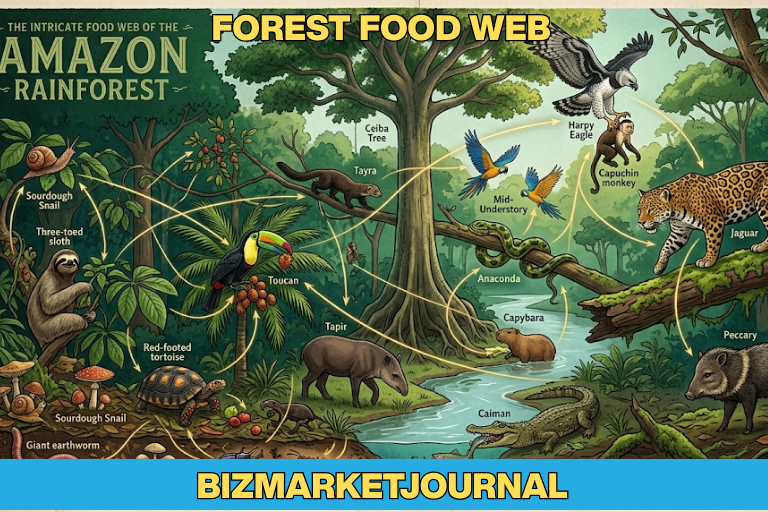
The foundation of Cheboygan County’s Amazon rainforest food web is composed of primary producers—plants, lichens, and fungi—that convert sunlight into energy through photosynthesis and support all higher trophic levels. These producers form the base of both temperate forest food webs in Michigan and, conceptually, Amazon rainforest analogs, highlighting universal ecological principles of energy flow and nutrient cycling.
Key Plant Species: Aspen, Red Pine, Sugar Maple
- Aspen (Populus tremuloides): Rapid-growing, sun-loving trees that provide leaves for herbivores and shelter for birds.
- Red Pine (Pinus resinosa): Dominant conifer providing seeds for small mammals and insects; forms dense canopy for shade-tolerant understory plants.
- Sugar Maple (Acer saccharum): Produces sap rich in sugars; leaves feed herbivores; contributes significantly to autumn nutrient cycling.
These species anchor the forest ecosystem, providing primary energy sources and structural habitat for wildlife.
Lichen, Fungi, and Soil Microbiome (Mycorrhizae)
- Lichens: Symbiotic organisms critical for nitrogen fixation, early colonizers on rocks and fallen logs, and seasonal food sources for invertebrates and small mammals.
- Fungi: Decomposers breaking down dead organic matter; form mycorrhizal networks that enhance nutrient absorption for trees and understory plants.
- Mycorrhizae: Essential underground partnerships between fungi and plant roots, increasing water and mineral uptake while stabilizing soil health.
These producers and symbionts maintain the forest’s invisible energy flows and nutrient cycles, supporting higher trophic levels.
Photosynthesis and Carbon Sequestration Impact
- Northern hardwood-conifer forests in Cheboygan County sequester significant atmospheric carbon annually.
- 2026 research from UM Biological Station (UMBS) shows that sugar maples and aspen contribute up to 15–20% of local forest carbon storage.
- Healthy producer layers buffer climate change effects and stabilize the ecosystem for both herbivores and apex predators.
Summary
Primary producers—including aspen, red pine, sugar maple, lichens, and mycorrhizae—form the base of Cheboygan County’s temperate forest food web. They supply energy, structural habitat, and maintain soil fertility, directly influencing herbivore populations and predator-prey dynamics.
Key Takeaways
- Aspen, red pine, and sugar maple provide the bulk of energy for herbivores.
- Lichens and fungi support nutrient cycling and soil health.
- Mycorrhizal networks enhance tree growth and ecosystem resilience.
- Healthy producers ensure a stable forest food web from primary consumers to apex predators.
Pros & Cons: Producers in the Northern Hardwood-Conifer Forest
Pros
✔ Sustain herbivore populations and biodiversity
✔ Facilitate carbon sequestration and climate resilience
✔ Provide habitat and cover for multiple species
✔ Support soil health through mycorrhizal networks
Cons
✘ Vulnerable to invasive plant species and disease outbreaks
✘ Susceptible to climate-driven stress (drought, extreme cold)
✘ Logging or human disturbance reduces primary energy availability
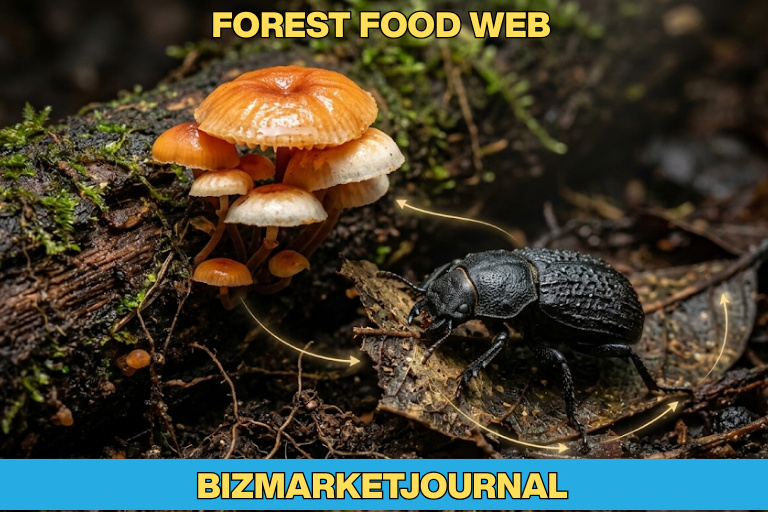
Trophic Levels: Mapping the Forest Food Chain in the ‘Big Wild’
Cheboygan County’s forest food web consists of interconnected trophic levels, where energy flows from primary producers to apex predators. Understanding these interactions provides insight into ecosystem stability, species behavior, and conservation priorities. In 2026, Northern Michigan forests exemplify temperate forest dynamics, allowing comparisons to complex systems like the Amazon rainforest food web.
Primary Consumers: Elk, White-tailed Deer, Snowshoe Hare
- Elk (Cervus canadensis): Graze on grasses, shrubs, and young trees; influence vegetation structure and understory density.
- White-tailed Deer (Odocoileus virginianus): Key herbivores controlling plant community composition; overpopulation can cause overbrowsing.
- Snowshoe Hare (Lepus americanus): Seasonal fluctuations impact predator populations; consume shrubs and low-lying plants.
Primary consumers are essential for transferring energy from plants to secondary consumers while shaping vegetation patterns.
Secondary Consumers: Snowy Owl, American Marten, Red Fox
- Snowy Owl (Bubo scandiacus): Feeds primarily on small mammals; seasonal migration affects local prey dynamics.
- American Marten (Martes americana): Small carnivore preying on rodents, birds, and insects; indicator of forest health.
- Red Fox (Vulpes vulpes): Opportunistic predator balancing small mammal populations and preventing herbivore overpopulation.
Secondary consumers regulate primary consumer numbers, indirectly supporting forest regeneration and biodiversity.
Apex Predators: Gray Wolves, Black Bears
- Gray Wolves (Canis lupus): Reintroduced populations restore predator-prey balance, controlling deer and elk numbers; their presence triggers trophic cascades.
- Black Bears (Ursus americanus): Omnivorous apex predators consuming plants, insects, and small mammals; influence seed dispersal and foraging patterns.
Apex predators maintain ecosystem stability, preventing herbivore overabundance and encouraging diverse plant communities.
Similar to how energy transfers between species in a forest food web, check out our Best A1 Soul Food Guide 2026: Must-Try Menu to understand how main dishes, sides, and desserts interact in a balanced meal.
Trophic Levels in Northern Michigan Forests
| Trophic Level | Species / Examples | Role in Ecosystem |
|---|---|---|
| Primary Producers | Aspen, Red Pine, Sugar Maple, Lichen | Convert sunlight into energy; carbon sequestration |
| Primary Consumers | Elk, White-tailed Deer, Snowshoe Hare | Herbivory; energy transfer to secondary consumers |
| Secondary Consumers | Snowy Owl, American Marten, Red Fox | Regulate primary consumers; maintain vegetation balance |
| Apex Predators | Gray Wolves, Black Bears | Control herbivore populations; trophic cascade effects |
Summary
Cheboygan County forests operate through clear trophic levels: producers supply energy, primary consumers transfer it, secondary consumers regulate populations, and apex predators stabilize the system. This structure mirrors principles found in tropical Amazon rainforest food webs, highlighting universal ecological dynamics.
Key Takeaways
- Primary consumers (elk, deer, hare) feed directly on plants, transferring energy upward.
- Secondary consumers regulate small mammals and herbivore populations.
- Apex predators maintain overall forest balance through trophic cascades.
- Energy flow and species interactions demonstrate temperate forest parallels to Amazon rainforest dynamics.
Pros & Cons: Trophic Level Dynamics
Pros
✔ Maintain biodiversity and ecosystem stability
✔ Control overpopulation of herbivores
✔ Promote healthy vegetation and carbon storage
✔ Provide measurable data for ecological research
Cons
✘ Predators may come into conflict with human activities
✘ Herbivore overpopulation can occur if apex predators are absent
✘ Seasonal variability affects energy availability and population balance
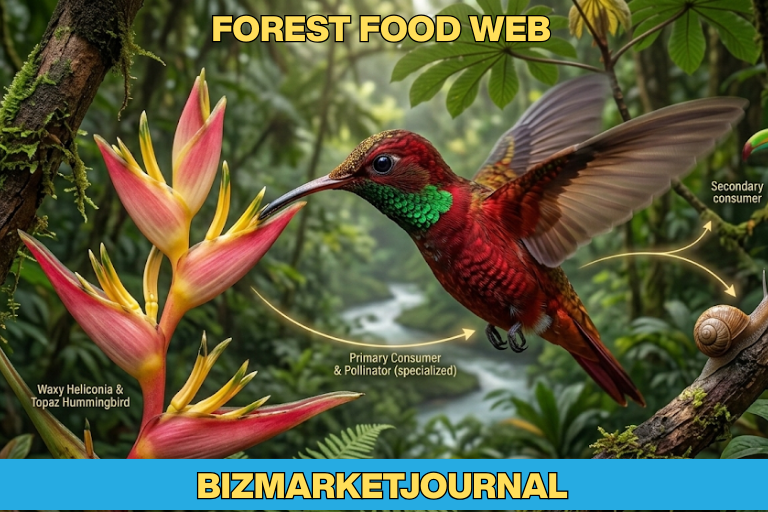
Keystone Species: The Role of Elk and White-Tailed Deer
Keystone species are organisms whose impact on ecosystem structure and function is disproportionately large relative to their abundance. In Cheboygan County’s northern hardwood-conifer forests, elk and white-tailed deer serve as critical keystone species, shaping vegetation patterns, supporting predator populations, and influencing overall biodiversity. Their presence and behavior provide essential insights into temperate forest food web dynamics.
Herbivore Influence on Vegetation and Biodiversity
- Elk: By selectively grazing on shrubs and young trees, elk prevent overgrowth in some areas while allowing less competitive plant species to thrive. This creates a mosaic of habitats, supporting birds, insects, and small mammals.
- White-tailed Deer: High deer populations can suppress understory plants, reducing biodiversity and altering forest composition. Conversely, balanced deer numbers encourage healthy regeneration of sugar maple and aspen seedlings.
Their feeding behavior directly affects primary producer distribution, influencing energy availability across trophic levels.
Predator-Herbivore Dynamics and Ecosystem Stability
- The presence of Gray Wolves and other predators regulates herbivore populations, reducing overbrowsing by deer and elk.
- Predation pressure influences herbivore movement patterns, allowing plant communities to recover in areas less frequently grazed.
- Seasonal shifts in herbivore activity affect secondary consumers, maintaining predator-prey balance and fostering ecosystem resilience.
These interactions demonstrate the trophic cascade effect, where keystone species indirectly control forest structure and biodiversity.
2026 UMBS Research Insights
- Studies at UM Biological Station (UMBS) indicate that moderate elk and deer densities enhance understory plant diversity by up to 35% in monitored plots.
- Carbon sequestration is indirectly supported by keystone herbivores through selective grazing that promotes long-lived, high biomass trees.
- Predator reintroduction programs in the Pigeon River area have led to measurable reductions in overbrowsing, illustrating the importance of maintaining natural keystone dynamics.
Keystone Species Impact Matrix (Table)
| Keystone Species | Ecological Role | Impact on Forest Food Web |
|---|---|---|
| Elk | Selective grazer | Shapes vegetation patterns, supports habitat diversity |
| White-tailed Deer | Generalist herbivore | Controls understory density, influences plant species distribution |
| Gray Wolves (indirect) | Apex predator regulating herbivores | Prevents overbrowsing, stabilizes trophic cascades |
Summary
Elk and white-tailed deer are keystone species in Cheboygan County forests. Their grazing habits and interactions with predators shape vegetation, maintain biodiversity, and support stable food web dynamics in temperate forests.
Key Takeaways
- Keystone herbivores regulate plant communities and energy distribution.
- Predator-herbivore dynamics prevent overbrowsing and maintain ecosystem balance.
- Research shows positive impacts on biodiversity and carbon sequestration.
- Maintaining keystone species is critical for healthy forest food web function.
Pros & Cons: Keystone Species Influence
Pros
✔ Promote vegetation diversity and habitat complexity
✔ Support healthy predator-prey interactions
✔ Enhance forest resilience and carbon storage
✔ Provide measurable ecological indicators for research
Cons
✘ Overpopulation without predators can lead to habitat degradation
✘ Human-wildlife conflicts may arise with large herbivores
✘ Ecosystem balance is sensitive to predator and herbivore population fluctuations

Decomposers and Soil Health: The Forest’s Invisible Engine
While producers and consumers are often visible, decomposers form the critical yet hidden engine of Cheboygan County’s forest food web. Fungi, bacteria, and other microorganisms recycle nutrients, maintain soil fertility, and support energy flow from dead organic matter back into the ecosystem. Their role is crucial for sustaining temperate forest ecosystems and mirrors nutrient cycling processes seen in tropical Amazon rainforest food webs.
Fungi, Bacteria, and Nutrient Cycling
- Fungi: Break down leaf litter, dead wood, and animal remains; form mycorrhizal networks connecting plant roots and facilitating nutrient transfer.
- Bacteria: Decompose organic matter, releasing nitrogen, phosphorus, and other minerals into the soil.
- Invertebrates (e.g., earthworms, insects): Mechanically fragment organic matter, increasing surface area for microbial decomposition.
Together, decomposers close the energy loop in the forest, returning essential elements to producers and supporting primary consumers.
Carbon Storage and Soil Fertility
- Decomposers contribute indirectly to carbon sequestration by controlling the rate of organic matter breakdown.
- Healthy soil communities improve water retention, support tree growth, and buffer against erosion.
- 2026 studies from UM Biological Station (UMBS) demonstrate that temperate forests with active decomposer populations store 10–15% more carbon than degraded areas with reduced microbial activity.
Impacts of Invasive Species on Decomposer Efficiency
- Non-native plants and pests can disrupt nutrient cycling by altering litter quality or outcompeting native fungi and bacteria.
- Invasive earthworms in northern Michigan accelerate decomposition in some areas, sometimes reducing organic matter accumulation and soil fertility.
- Managing invasive species is essential to maintain decomposer efficiency and overall forest health.
Summary
Decomposers—fungi, bacteria, and invertebrates—form the forest’s invisible engine, recycling nutrients, maintaining soil fertility, and supporting the temperate food web. Their activity directly impacts carbon storage, plant growth, and ecosystem resilience.
Key Takeaways
- Decomposers recycle nutrients from dead organic matter back into the forest ecosystem.
- Mycorrhizal fungi and bacteria improve plant nutrient uptake and soil health.
- Active decomposer populations enhance carbon storage and water retention.
- Invasive species can disrupt decomposer efficiency and nutrient cycling.
Pros & Cons: Decomposer Function in Forest Ecosystems
Pros
✔ Maintain nutrient availability for producers
✔ Support carbon sequestration and soil health
✔ Enable energy flow across trophic levels
✔ Enhance forest resilience to environmental stress
Cons
✘ Invasive species may disrupt nutrient cycling
✘ Soil degradation reduces decomposer populations
✘ Human disturbance (logging, pollution) can impair microbial activity
Conclusion:
Cheboygan County’s forests exemplify the intricate balance of a temperate forest food web, where producers, consumers, apex predators, and decomposers interconnect to maintain ecosystem stability. From aspen and sugar maple supporting herbivores like elk and white-tailed deer, to apex predators such as gray wolves regulating populations, and decomposers recycling nutrients, every component contributes to forest health. 2026 research from UM Biological Station (UMBS) and Michigan DNR highlights predator-prey restoration, carbon sequestration, and soil fertility as key indicators of ecosystem resilience. Understanding these dynamics is essential for conservation, academic study, and sustainable forest management in northern Michigan.
Frequently Asked Questions
1. What is an Amazon rainforest food web?
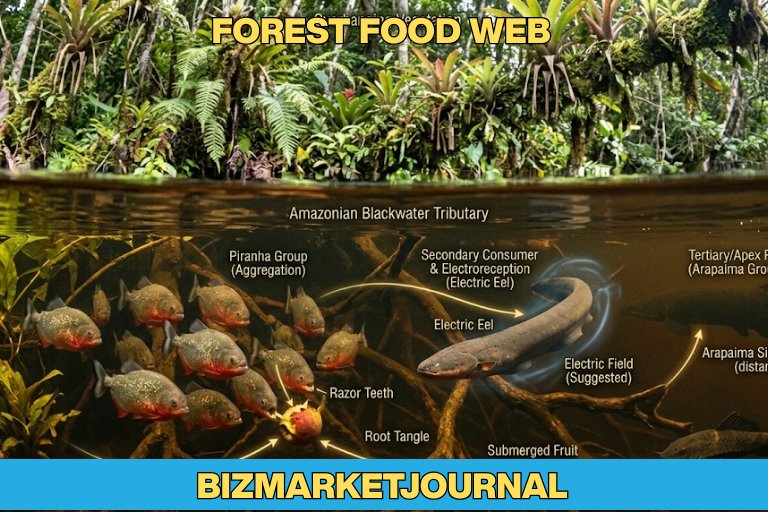
An Amazon rainforest food web is a network of energy transfer among producers, consumers, and decomposers in tropical forests, showing how species interact to sustain biodiversity.
2. How does the temperate forest food web differ from the Amazon rainforest?
Temperate forests like Cheboygan County have seasonal changes, fewer tropical species, and keystone herbivores such as elk and white-tailed deer, whereas Amazon forests have year-round productivity and high species diversity.
3. Which are the primary producers in Cheboygan County forests?
Key producers include aspen, red pine, sugar maple, lichens, and mycorrhizal fungi, forming the foundation for energy flow to herbivores.
4. Who are the apex predators in northern Michigan forests?
Gray wolves and black bears regulate herbivore populations, maintain biodiversity, and trigger trophic cascades that stabilize the ecosystem.
5. Why are elk and white-tailed deer considered keystone species?
Their feeding behavior shapes vegetation patterns, supports habitat diversity, and indirectly influences predator populations and overall forest health.
6. How do decomposers impact the forest food web?
Fungi, bacteria, and invertebrates recycle nutrients, maintain soil fertility, enhance carbon sequestration, and support primary producers.
7. What 2026 research highlights forest ecosystem health in Cheboygan County?
UMBS studies emphasize predator-prey balance restoration, carbon sequestration by temperate forests, and the role of decomposers in sustaining soil fertility and biodiversity.
References
- UM Biological Station (UMBS) – Long-term ecological research on temperate forests and predator-prey dynamics.
- Michigan Department of Natural Resources – Northern Michigan wildlife population and habitat management reports.
- Northern Michigan Forest Carbon Sequestration Studies – 2026 UMBS publications.
- Academic journals: Ecology, Forest Ecology and Management, Journal of Wildlife Management.
- Local biodiversity surveys – Pigeon River Country State Forest, Douglas Lake, Burt Lake monitoring programs.
- Invasive species impact research – Michigan State University Extension and UMBS collaborative studies.